The construction client who resells the AI we built them
Concreto, a fourth-generation Argentine construction group running several jobsites at once, ran its back office on scattered spreadsheets, WhatsApp photos, and paper. Work-Smart built Capataz, a custom AI operations brain that answers questions across job documents, tracks certifications and costs, and keeps personnel compliance current. The group now resells Capataz to other builders.

The losses are not on the building. They are in the back office.
A construction group does not lose money on the building. It loses it in the back office, the part everyone puts last. Concreto ran that back office on a pile of spreadsheets that no two clients formatted the same way, plus WhatsApp photos and paper that someone had to rebuild into a payroll register every fortnight.
Payroll was rebuilt from those WhatsApp photos and paper records, three full days every two weeks. Compliance documents were tracked by hand under the threat of an inspection that can halt a site. Cost deviations were consolidated by hand on a roughly monthly lag, against a real margin in the single digits. The people doing the clerical work were the experts who should have been doing the analysis.
Generic AI was a non-starter. The numbers in a certification are billed money, so a wrong figure is not a small mistake, it is invoiced loss. The documents are contracts and payroll, not something to paste into a public chatbot. And a tool that nobody on a jobsite will open is worthless. The brief was specific from the start: build something the foremen, the cost lead, and the CEO would all actually use, on the group's own documents, in the group's own systems.
The engagement became an AI Foundation Build followed by a Fractional Head of AI retainer that continues today. Capataz, the CLAUDE.md, the data model, and the cost dashboard all sit in Concreto's accounts. The group owns everything that was built.
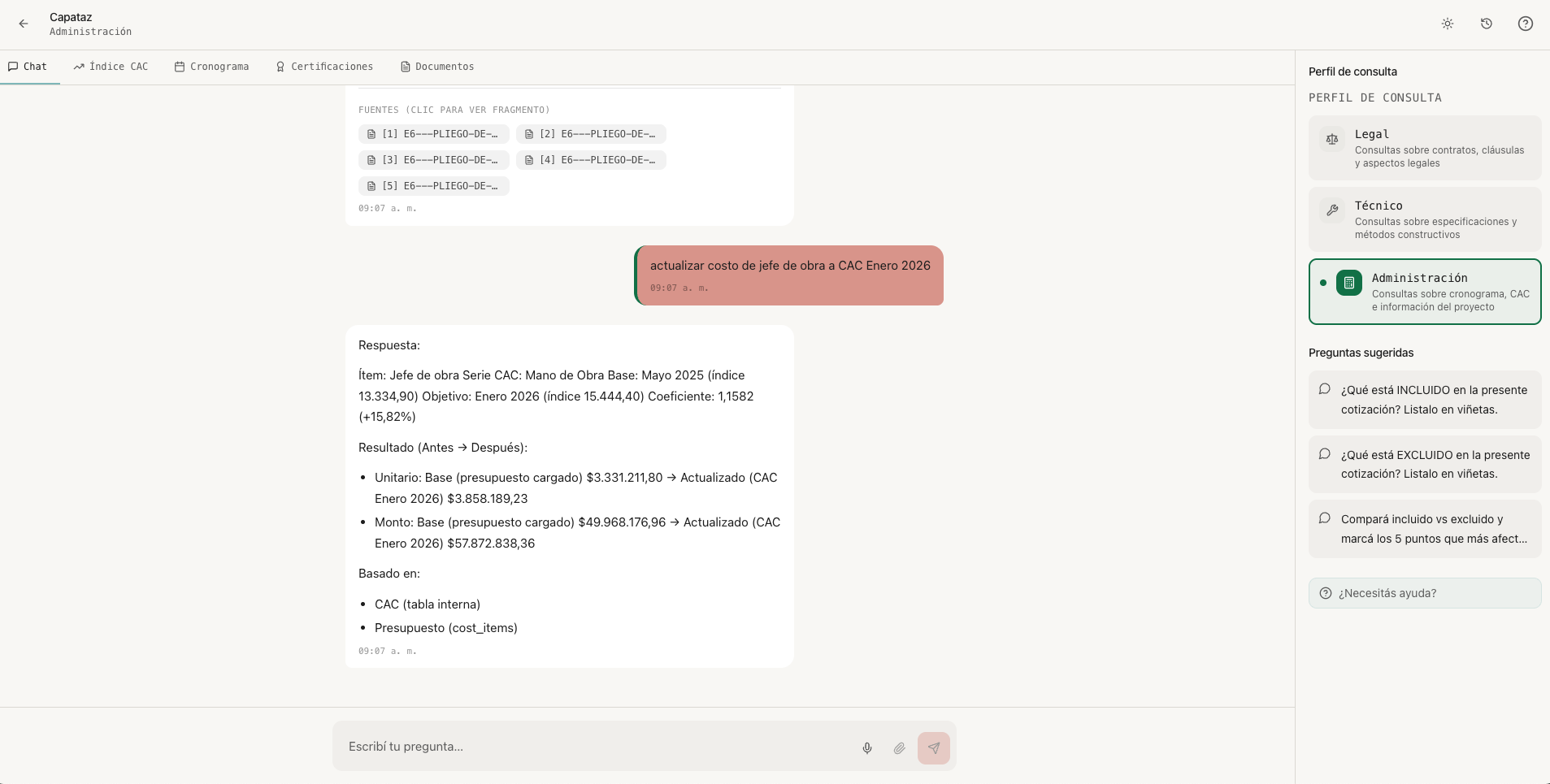
One operations brain. Three role-aware profiles. The source behind every answer.
Capataz is a custom AI operations brain built on the group's own documents. Anyone on the team can ask it anything across a job's contracts, certifications, and cost sheets in plain language. It updates costs against the construction index automatically. It keeps a live personnel panel with expiry alerts, so the firm stays inspection-ready instead of scrambling when an inspector arrives. It turns a report that used to take a full day, like summing payroll by hand across twenty-four pay periods, into one click, with the source behind every figure.
It does not invent numbers. Every answer traces to the document it came from. Where a calculation cannot be proven from the source, the system flags it instead of guessing. A person still decides.
The clearest sign that the system works is who said so first. A foreman, the cost lead, and the cost-analysis team each described their own worst task and said the same thing in their own words: that is exactly what I needed, it would change my life. The strongest proof, though, is commercial. The group liked Capataz enough to start selling it to other builders. That is not an outcome anyone manufactures. It happens when a tool earns its place on the jobsite.
Capataz was the first build, not the last.
Concreto owns what was built. The system keeps growing with new workflows, new checks, and a monthly working session that sets the next priorities. For the broader pattern in this vertical, see the construction industry page. For the recurring-report version of the same pattern, applied to investor reporting at a fourth-generation real-estate developer, see the automated investor reporting case study. For construction firms in South Florida, see AI for construction in Miami.
And every month, the system does more than the month before.
Capataz, the document-grounded operations brain
The first build was a search bar over the group's own documents. Capataz reads from contracts, technical specifications, certifications, and cost sheets, and answers questions in plain language with the source behind every figure. It does not search the internet and it does not invent numbers. Three role-aware profiles handle legal, technical, and administrative queries. The brain also connects to Argentina's construction cost index so per-job costs update against inflation automatically.
The cost and certification engine
The deeper problem was that cost data and certification data lived in parallel universes. What gets billed and what gets spent were never compared in real time. We restructured the cost model so every line item maps to a numbered group and category, and every certification line links to the cost item it covers. The result is a live view of contracted value, inflation-adjusted costs, cumulative certifications, and, most importantly, the deviation between budgeted spend per phase and actual spend, so a job starting to slip surfaces immediately instead of at the next monthly close.
Schedule tracking with cost-impact alerts
Construction schedules slip. The question is how fast the group detects the slip and what it costs them. We built phase-by-phase tracking that shows which phases are on track and which started late, and we linked each phase to its cost impact, so a delay reads as the financial exposure it actually is, idle workers, equipment rental, overhead, not just a calendar problem.
Field-facing layer plus monthly retainer
With the data structured and the brain working, the next layer turned operational. Field supervisors report progress directly into the system. Photos of receipts and materials get extracted into cost categories automatically. Personnel compliance, certifications, expiry alerts, and HR documentation for the active workforce live in one panel so the group stays inspection-ready. Each month the retainer adds new modules and keeps the brain current.
- ▸Operators in different roles, costs, HR, cost analysis, each saw their own worst task solved and said so. The strongest proof is commercial: the group liked Capataz enough to start selling it to other builders, an outcome that does not happen unless the system actually works on a jobsite.
- ▸The clerical hours that used to be three full days every two weeks are no longer the bottleneck. The people doing that work are back to the analysis they should have been doing all along.
- ▸Certification preparation moved from manual reconciliation across disconnected spreadsheets to structured data with automatic cost-to-certification linking. Cost-index updates went from monthly manual lookups to automatic.
- ▸Document search across contracts and specifications went from a dig through PDFs and filing cabinets to AI search with the source behind every answer.
- ▸Margin recovery is a path, not a switch. The infrastructure to detect deviations now exists. Closing the gap on what was once a real margin in the single digits is ongoing work, and that is what the monthly retainer covers.
Questions About This Case Study
The first version of Capataz, AI document search and cost tracking, shipped in about eight weeks. The full system, including the certification engine, schedule tracking, and deviation alerts, was built over nine months. Construction is complex. The technology is straightforward; the data restructuring and field adoption take time.
This was an AI Foundation Build engagement followed by a monthly retainer. The build was scoped in milestones tied to deliverables: the Capataz brain, the cost and certification engine, schedule tracking, and the field-facing layer. The retainer covers new workflows, new checks, and field-team support. Pricing depends on the number of active jobs and the data complexity; the AI Ops Audit scopes the exact starting point.
Yes. The operational pattern is consistent across construction groups in this size range: spreadsheet-driven cost tracking, disconnected schedules, manual certifications, and no real-time visibility. The specific cost categories and certification structures change, but the infrastructure is the same. The starting scope depends on how many active jobs you are managing and how your data is currently structured.
No. Concreto did not replace anything. We connected to their existing data, restructured it into a proper model, and built on top of what they already had. Field teams use the tools they know; the difference is that the data now flows into a central brain instead of sitting in disconnected files.
Concreto is on a monthly retainer. Each month adds new Capataz modules, data-model updates as new jobs come online, field-team training, and system maintenance. The group also resells Capataz to other builders, so the engagement keeps growing with their commercial use of the system.
The interface is a search bar. You type a question about a job and you get an answer in seconds, pulled directly from the group's own documents, with the source behind every figure. Field engineers who had never used a computer for project management adopted it because the output was immediately useful from day one.
A fourth-generation real-estate developer
Quarterly investor reporting, reproducible to the cent
Read case study →A commercial property management firm
AP automation, paper book to private AI workspace
Read case study →If your construction group is running the back office on spreadsheets and paper, and you only see margin problems weeks after the money is gone, you are where Concreto was.
The AI Ops Audit is how every engagement starts. Two to four weeks, fixed-fee, and you will know exactly where your margin is leaking and what it takes to fix it.